

A friend of mine has wanted to move to Vietnam for years. He was born in Europe, like me, to Vietnamese parents who left and built their lives somewhere else. He visits whenever he can. He talks about the country more than he talks about the one he lives in. He has the kind of resume that opens doors anywhere, a top MBA, a management consulting job, the whole track. A few years ago he asked his firm to send him to its Vietnam office. It did not work out. He let it drop and took a job in London instead, and that is more or less where the story has stayed.
Here is the thing about him, and about a lot of us. He knows Vietnam is rising. He feels the pull of it, more every year. And yet nothing makes it urgent enough to act on today, so he does the reasonable thing and takes the next strong step in the career already in front of him, telling himself he will go when he is more ready, more senior, better cushioned against the risk. Every year Vietnam gets louder and his life somewhere else gets more settled. Vietnam is not waiting for him. Later keeps sliding forward, and the move he is always about to make stays a move he never makes.
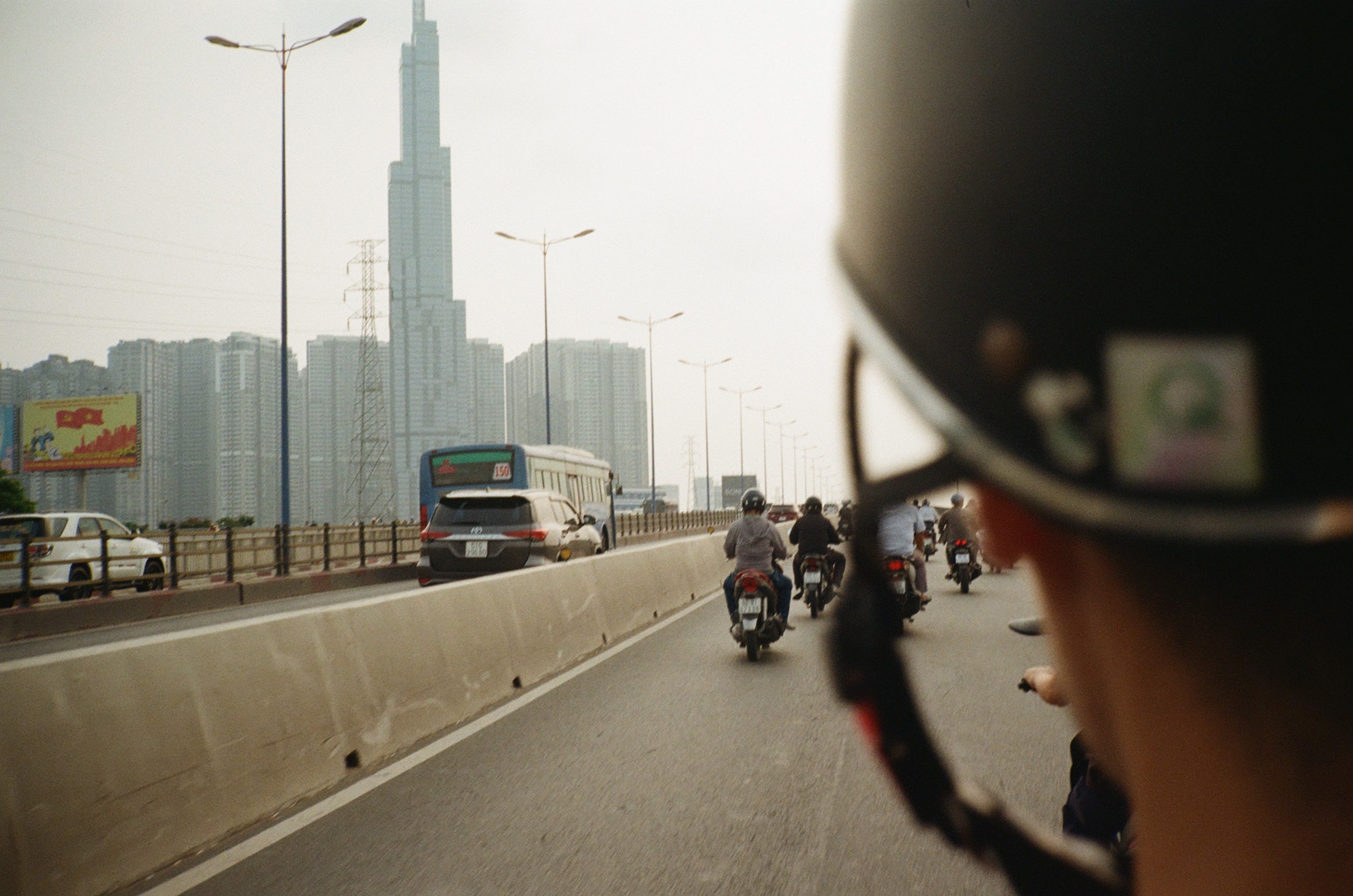
I understand it, because I have felt the pull myself. It is stronger than most non-Vietnamese would guess, and stronger than most local Vietnamese would believe. You land in Saigon and the place hits you all at once. The heat, the noise, motorbikes coming from every direction, and the unmistakable feeling of a place on its way up. It is chaos at first, after a few days it turns into energy, and after a week you do not want to leave. Everything feels possible in a way it does not back in the West. You can be drinking coffee on a plastic stool on the sidewalk and look up at a concrete tower rising across the road, the old country and the new one in a single glance.
And it is yours, sort of. These are your people. This is where your parents are from. You hear the language your mother spoke and you understand most of it, and then you go to say something and find your Vietnamese is not enough to say what you mean. You belong and you do not, at the same time.
That double feeling is most of what the diaspora has in common. It is also where the gap is. Wanting Vietnam and knowing Vietnam turn out to have almost nothing to do with being able to take part in it. You can love the place, speak some of the language, have family there, fly back every year, and still have no idea how you would build a life there. You know the country by heart. Except the country keeps moving, and the version you know is already a step behind.
The way in is not obvious from the outside. The job worth having, the partner worth trusting, the deal worth doing, moves between people who already know each other. What is public is not public if you did not grow up knowing where to find it. Finding it requires a kind of local fluency most of us never had. So the opportunities reach the few who go hunting for them, and pass everyone else by.
Finding Each Other
I run a community called Overseas Vietnamese, OV for short. It started as nothing, a group I put online because I wanted it to exist and it did not, and it grew into a global network of a thousand Vietnamese professionals, most of them wrestling with the same question my friend is. I have watched this play out enough times to stop believing it is about loyalty, desire, or even nerve. It is about access.
I know this because I lived it, from the beginning. For a long time it was not much fun to be overseas Vietnamese. Our parents arrived and started from zero, built what could be built without language or a diploma: restaurants, nail salons, corner shops, Asian grocery stores.
We grew up in between, a little embarrassed by the rice in the lunchbox when the other kids had sandwiches, the name no teacher could pronounce and other kids turned into a joke, the whole business of being the Asian kid, sometimes the outsider. A lot of us spent our early years trying to be less Vietnamese.
Then, somewhere along the way, things began to change. The food the other kids used to mock became the thing they lined up for. People started going to Vietnam on holiday and coming back talking about it like a discovery. The country climbed onto the world stage, and the story moved from war and poverty to the place everyone now says is next. We looked up and found each other, all of us who had grown up half in and half out, and saw that we were not alone and not embarrassing. We were more than we had been made to feel.
It is now a great time to be overseas Vietnamese. I do not think most of us have stopped to realize what a moment this is.
Why Now
Not every diaspora gets to watch its homeland rise within one lifetime. Look at the conditions. There are about six million of us, scattered across more than 130 countries. That is a useful size. The Chinese and Indian diasporas are far larger, but they are also split across languages and centuries of separate migration waves, so no single network could ever reach more than a fraction of either one. We are also not so few that we would be a rounding error. We arrived in a few waves over a few decades, so we are close in age and close in experience, near enough that our parents grew up fully Vietnamese, born and raised in it before the world pulled them elsewhere. And the place we are tied to is not the faded memory of somewhere poor. Today, it is one of the fastest-growing economies in Asia, rising now while we are still close enough to be part of it.
That alignment will not hold. Each generation born abroad sits a little further from the country than the one before. The closeness we have right now, the language, the living memory, the sense that Vietnam is ours and not only our parents’, is the most we will ever have, and it is already thinning. If there was ever a window to turn a scattered generation into one with something in common, and maybe a direction, it is open now.
None of that is enough on its own. Wanting Vietnam is not the problem. The way in is.
Three things stand between a willing person and a life here. You cannot see what opportunities exist, let alone which ones are worth chasing. You cannot be seen by the people who could bring you in, and it would not occur to them to look for you either. And you cannot build the trust that would let either side take a chance on the other. In a place that runs on relationships, there is no way in without one, and no way to build one without already being in.
This is not a Vietnamese flaw. It is what most economies look like before their institutions finish forming. Where formal systems are still catching up to how fast things move, and strangers do not easily trust each other, people rely on the relationships they already have to do what law and markets would otherwise do. Outside that network, you are mostly on your own.
So the people who make it across tend to be the same few. The risk-takers go looking for the opportunity on purpose, and pursue it regardless of what they already have to lose. The ones with little to lose often end up staying almost without meaning to, drawn by the lifestyle rather than any deliberate plan. Everyone else, the largest group, is too settled to chase this on their own and too committed elsewhere to end up there by chance. Deep in demanding careers, they have little time to explore and little appetite for betting on a place that has not yet proven itself to them, so Vietnam never seriously enters the frame.
The Stakes
Vietnam has tried to close the gap from its side, and the effort has been serious. Over the past two decades it opened dual citizenship, gave overseas Vietnamese the same right to own property as locals, and as recently as 2025 made it easier to reclaim Vietnamese nationality. It went further, with a dedicated state committee, diaspora conferences, and advisory panels of prominent overseas experts.
And still, the results have not matched the ambition. Truong Gia Binh, a local entrepreneur who built FPT into Vietnam’s largest technology company, has been blunt about what brings talent home. Before anything else, he says, people need the chance to build something. That should be the encouraging part. The wanting he is describing is already out there, in people exactly like my friend.
It would be a soft story about belonging if nothing were at stake. Something is.
Vietnam has set itself a hard target: high income by 2045, the hundredth year of its independence. The odds are humbling. Of nearly two hundred developing economies since 1950, only about a dozen ever climbed from the middle to the top, most of them in East Asia. The rest stalled. The ones that made it did it by owning the higher-value work, the technology, the research, the brand, not just assembling what someone else designed. Vietnam is reaching for that exact work now.
It has begun. Vietnam has set a target of fifty thousand semiconductor engineers by 2030. NVIDIA chose Vietnam for one of its major AI research centers. Its CEO, Jensen Huang, has said he wants Vietnam to be the company’s second home. A new international financial center, launching across Ho Chi Minh City and Da Nang, will need more than ten thousand finance professionals. Filling those roles takes more than headcount. Some of it requires people who already have experience inside the world’s leading technology and financial hubs, and overseas Vietnamese are a key part of that group, already working in Silicon Valley, New York, London and Singapore.
Vietnam is competing for the talent those hubs already have. It cannot outbid New York or Singapore for that talent, not yet. What it can do is out-belong them. The open market goes to the highest bidder, and Vietnam rarely wins that auction. But some of the best people in the world will choose a place for reasons no salary covers, because it is where they are from. Those people are the one pool Vietnam can win outright, on a basis no competitor can copy, since no rival can offer to be where someone is from.
Winning them does not mean being saved by them. The diaspora does not fly in to save anyone, and the version of this story where it does is one Vietnam has heard before and learned to resent. The country will be built first by the people who never left, who know the market and the language and the way things work in a way no returnee can fake. What the diaspora carries is the connection, the capital and the link to markets the country is still reaching for. The vision and the company still belong here.
Proof of Concept
Vietnam has already seen exactly what that looks like, in the career of one engineer. Vo Quang Hue studied engineering in Germany, then spent twenty-four years at BMW, before Bosch recruited him in 2006 to build its business in Asia. He convinced Bosch to choose Vietnam over China, then the more obvious bet, and personally built its Vietnam operation from nothing, a manufacturing plant and an R&D center that grew into one of Bosch’s largest in Southeast Asia. He was getting ready to retire when Pham Nhat Vuong, Vingroup’s founder and Vietnam’s richest man, called and asked him to help build the country’s first homegrown car in two years. Hue thought it was nearly impossible. He built it anyway, and VinFast’s first car rolled out in under two years, a pace the industry had never seen.
One engineer is proof of concept. Countries are proof at scale. In the 1980s Taiwan was losing its best engineers to Silicon Valley, for the graduate programs and industry jobs Taiwan did not yet have. At the peak, in 1979, only eight percent of the students it sent abroad came home.
Taiwan did not wait this out. Its own policymakers, many of them US-trained engineers themselves, reached out directly to Taiwanese working at Bell Labs and across Silicon Valley for advice on how to build something worth returning to, then opened a venture capital industry and Hsinchu Science Park, modeled on Silicon Valley. More than half the companies that came out of the park had been founded by returnees, TSMC among them. Its founder, Morris Chang, was one of them, MIT-trained, decades in America, recruited home by Taiwan’s own government. TSMC is now the maker of more than nine in ten of the world’s most advanced chips.
The scholar who studied them, AnnaLee Saxenian, called the pattern “brain circulation”, the answer to brain drain: talent that leaves, sharpens abroad, and comes home able to build what neither place could have built alone.
China’s returnees carried what Taiwan’s did, and something more. The ones who came back, the “sea turtles”, founded Baidu and Sohu. They brought more than skill. They brought ties to foreign money and markets, American investors who backed them because they were already known. For a decade, around half of the Chinese companies going public on Nasdaq were built by returnees.
Israel built a connection on purpose. In 1993 its government put up a hundred million dollars, not to fund companies, but to draw in foreign venture capital, matching what outside investors put in and letting them buy out its stake cheaply if the bet paid off. Venture funding rose sixtyfold in a decade, and a country of a few million became the place the world now calls Startup Nation. A small country used its ties to the wider world, and a fund built to channel them, to manufacture the venture capital industry it did not have before.
India shows the limit. The myth was that diaspora founders, Silicon Valley veterans coming home to Bangalore, built India’s unicorns. A recent study of nearly six hundred startups found the myth does not hold up. Locally rooted founders now outperform returnees on revenue, survival and growth. Returnees still have an advantage early, in funding and credibility. Locals build what lasts. So the diaspora is the connection, never the cure.
The Missing Piece
What turns a connection into results is different every time: Taiwan built a park, Israel built a fund. Vietnam has to build a professional network, one designed to reach a diaspora scattered across more than 130 countries. And the problem itself makes plain why. On one side, a generation of overseas Vietnamese, well-educated and globally trained, more open to the move than any before it. On the other, a country moving toward becoming a high-income, developed nation, exciting in its own right, and one this generation could help build along the way. Between them, not enough visibility, not enough structure, and no way across yet.
The sociologist Ronald Burt called this a “structural hole”: two dense clusters, each internally well-connected, with almost no ties running between them. The position of brokering that hole, not belonging to either side but connecting both, is where disproportionate advantage sits, in information, in opportunity, in trust. The diaspora and Vietnam fit the definition precisely. Building one network is how Vietnam occupies that brokerage position on purpose.
A network makes the invisible visible: a member hears about a role, an opportunity, or a person worth knowing, through the network or from another member, long before someone outside the network would ever think to go looking for it. It puts each side in front of the other: an employer sees a candidate whose intent to move is already known inside the network, something a candidate’s profile would rarely surface. And it gives both sides enough trust to act, because a reputation built inside the network means something outside it too. Together, that is net new value for both sides, and only a network creates it. But a network does not build itself. We have to build it.
Vietnamese are especially suited to building one, for two reasons. The first is trust, though not the automatic kind. Being Vietnamese does not make two strangers trust each other. There is old caution among us too. Shared heritage buys something smaller: curiosity, the same thing that made us find each other growing up half in and half out. What comes after is ordinary professional exchange: people help each other because it is good for both of their careers. That is why this has to be a professional network, not a social one. Trust here is earned, not assumed.
The second is timing. This generation has less of what divided the ones before it, is more forward-looking, drawn to Vietnam itself. A network like this could not have existed a generation ago. Technology and globalization also make it possible to stay close to each other, no matter where in the world we are. And Vietnam is rising at the same time. That convergence is the opportunity, and it will not last.
Building this well decides a great deal about the next ten years. Get it right and the results will be visible. Diaspora-founded companies among Vietnam’s most valuable. Returnee engineers and investors on the teams building it. A share of the country’s new semiconductor and finance jobs filled by people who chose to come home. Get it wrong and most of that readiness goes nowhere, not for lack of trying on Vietnam’s side, but for lack of a way across.
Building It
This is not the first attempt to organize the diaspora around Vietnam. Networks and associations for Vietnamese professionals have existed for decades. What has been missing is not the impulse to connect. It is scale: a network where the more of us who join, the more useful it becomes for every one of us already in it, and one that reaches back into Vietnam as naturally as it reaches across the rest of the world.
That is the network we are building. A French-Vietnamese can reach a returnee in Ho Chi Minh City through the same structure that reaches an Australian-Vietnamese on the other side of the world, and that structure runs into employers and institutions across Vietnam’s economy, including the new financial center now recruiting abroad. What members learn stays current because of it. Knowledge compounds inside a network this size in a way it never does alone: returnees sharing exactly how they made the move, professionals trading what is happening in a given industry right now, news from the ground replacing whatever is already stale by the time it goes public. Staying ready for Vietnam gets easier every year you are inside it.
All of that works because the network is global. Visiting Vietnam takes it further, direct contact with the market itself. Plenty of us already visit Vietnam every year to see family, but arrive without any way to meet the people already living the life we are only visiting. That kind of access does not come easily from outside, not to the people who know the market, and not to the companies that would need to hire you.
Once a year, we bring hundreds of overseas Vietnamese from everywhere home at the same time. We take them on tours through Vietnam’s leading businesses, and put them in conversation with people who already made the move and run things here now. That event is known as the OV Summit. For many, it has become the reason they come home at all. It sells out every year, and people build their travel plans around it.
There is one more barrier: our parents. Not all of them oppose the move back. Many are simply cautious, remembering the Vietnam they left, not the one it has become. None of us expected Vietnam to rise this much and this fast, our parents least of all. They left for something better, and a move back can feel like undoing that. No argument changes a mind formed that way. What does is simpler: one more story of someone who made the move and did well. A network is what gets that story to someone who needs to hear it.

None of this existed when I started, not the summit, not the connections, not even a way to reassure a parent. I was a kid in Germany, the son of blue-collar parents who wanted me in the white-collar world. I had no network and no way in, and my one idea was that there had to be other Vietnamese out there who were ahead of me and would help, if only there were a way to find each other. There was not, so I created one, and eventually moved to Vietnam myself. This is my life’s work now, and what drives it is this: a diaspora now able to connect globally and support one another, and a home country rising at the same time, are better with each other than without.
My friend still has not moved. He may never move, and that is his to decide. Vietnam is not for everyone, and no one owes it a homecoming. But if he ever wants it, a network now exists to make it easier. He would not have to find his way in through one failed request to his firm and a shrug. He would know who is hiring, who has already made the exact move he is considering, and what that first year took. Vietnam would be a place he can see, and a place that can see him.
Maybe you already know exactly who your version of him is. Maybe it is you. The wanting was there all along. Now the way in is too.
Learn more about Overseas Vietnamese at overseasvietnamese.com
You perfectly described the sensation of stepping foot for the first time in Saigon.
feels like you read my mind. Thanks Quang